


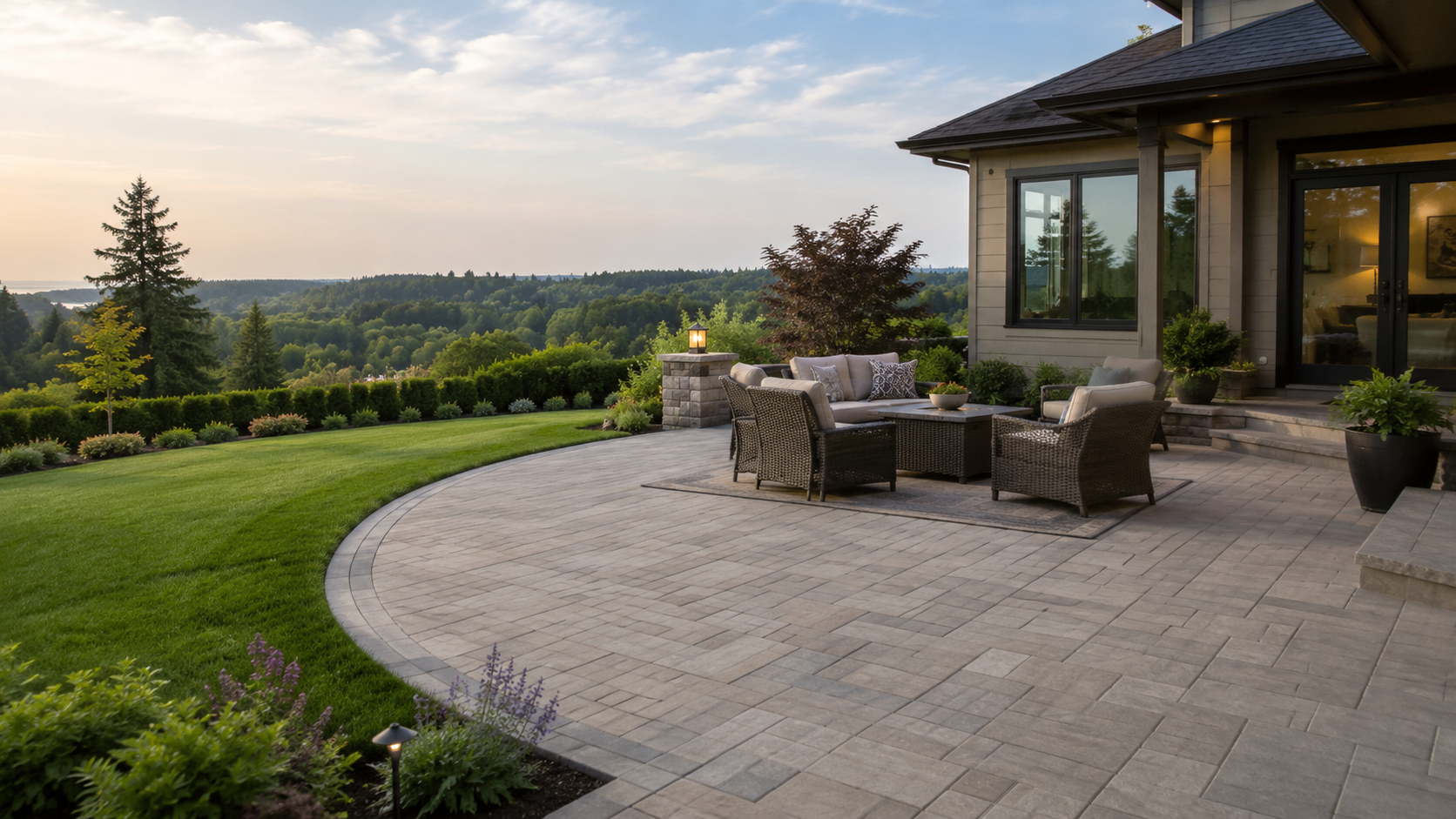
When you live in the Pacific Northwest, choosing a patio material is not just about looks. Rain, shade, moss, soil movement, drainage, and seasonal freeze-thaw cycles all affect how a patio performs over time.
For homeowners in Redmond, Kirkland, Bellevue, Woodinville, and nearby Eastside areas, the two most common options are paver patios and poured concrete patios. Both can create a functional outdoor living space, but they behave very differently in wet weather.
So which one is better for the Pacific Northwest?
For most residential backyard patios, pavers are usually the better long-term choice when they are installed correctly. They handle movement better, are easier to repair, offer better design flexibility, and can be built with drainage in mind. Concrete can still be a good option for certain budgets and simple layouts, but it is less forgiving once cracking, settling, or drainage problems show up.
Below, we’ll break down the real-world pros and cons of pavers vs concrete patios in wet PNW conditions.
Quick answer: are pavers or concrete better for wet weather?
In rainy climates like Western Washington, pavers usually have the advantage because they are installed as individual units over a compacted base. This allows the patio system to flex slightly with ground movement instead of cracking as one solid slab.
A properly built paver patio can also be repaired one section at a time. If an area settles, individual pavers can be lifted, the base can be corrected, and the pavers can be reinstalled. With poured concrete, cracking or settling is much harder to repair cleanly without visible patching or full replacement.
That said, pavers are not magic. They still need proper excavation, base compaction, edge restraint, joint material, and drainage planning. A poorly built paver patio can still sink, shift, collect weeds, or hold water.
If you are planning a new patio, our team provides paver patio installation in Redmond, WA with the base prep, grading, and drainage planning needed for Pacific Northwest conditions.
Pavers vs concrete patios: side-by-side comparison
| Category | Paver Patio | Concrete Patio |
|---|---|---|
| Wet weather performance | Strong when properly graded and installed over the right base | Good if properly sloped, but standing water can become an issue |
| Cracking | Individual pavers rarely create major visible cracking across the whole patio | Concrete is more likely to crack over time |
| Repairability | Individual pavers can be removed and reset | Repairs are often visible and may not match |
| Drainage | Can be built with joints, slope, base stone, and drainage planning | Depends heavily on surface slope and surrounding drainage |
| Slip resistance | Many pavers offer textured, slip-resistant surfaces | Smooth or sealed concrete can become slippery when wet |
| Maintenance | Joint cleaning, moss control, and occasional polymeric sand touch-ups | Cleaning, sealing, crack repair, and possible resurfacing |
| Design options | Many colors, patterns, borders, and textures | Simple broom finish, stamped concrete, or decorative finishes |
| Upfront cost | Often higher than basic concrete | Usually lower than pavers, unless stamped or decorative |
| Long-term value | Strong curb appeal and easier repair | Good when simple and well-installed, but less flexible |
Why wet weather changes the patio decision
A patio in Arizona and a patio in Redmond are not dealing with the same conditions.
In the Pacific Northwest, patios have to deal with:
- Long rainy seasons
- Shaded yards that dry slowly
- Moss and organic debris
- Clay-heavy or compacted soils
- Downspout runoff
- Sloped backyards
- Freeze-thaw cycles during cold snaps
- Wet leaves and surface buildup
These conditions make drainage and base prep more important than the surface material alone.
A beautiful patio can still fail if water has nowhere to go. That is true for both concrete and pavers. The difference is that pavers are often more forgiving when water, soil movement, or settling becomes an issue.
How paver patios handle rain
A standard paver patio is not the same thing as a fully permeable stormwater system. This is where a lot of homeowners get confused.
Most regular paver patios are designed to move water in a few ways:
- Surface slope directs water away from the house and toward a safe drainage area.
- Joints between pavers allow some water to move downward.
- The compacted base layer supports the patio and helps manage water movement.
- Edge restraints and proper grading keep the patio stable over time.
- Additional drainage solutions may be added when the yard has low spots, clay soil, or heavy runoff.
A permeable paver system is more specialized. It uses wider joints, specific aggregate, and an open-graded base that allows more water to move through the patio structure. The Federal Highway Administration has a helpful resource explaining how permeable interlocking concrete pavement works as a stormwater management system.
For most residential patios, the key point is this: pavers perform well in wet weather when the patio is designed as a complete system, not just a surface layer.
How concrete patios handle rain
Concrete patios can perform well in wet weather if they are installed with the right slope, thickness, reinforcement, control joints, and base preparation.
The challenge is that concrete is one continuous slab. When the ground underneath moves, settles, or holds water, the slab has limited flexibility. Over time, cracks can form. Control joints help guide where cracking occurs, but they do not guarantee that every crack will stay hidden or perfectly controlled.
Concrete can also become slick when wet, especially if it has a smoother finish or has been sealed. Stamped concrete can look great, but texture, sealer choice, and maintenance matter in rainy climates.
For simple patios with good access, proper drainage, and a tighter budget, concrete may still make sense. But for homeowners who want a more custom look, better repairability, and a surface that can be adapted to wet PNW yards, pavers usually offer more long-term flexibility.
Drainage: the biggest factor most homeowners overlook
When people compare pavers vs concrete, they often focus on the surface. But in the Pacific Northwest, the real question is what happens underneath and around the patio.
Ask these questions before choosing a patio material:
- Does the yard already have standing water?
- Does water flow toward the house?
- Are there downspouts dumping near the patio area?
- Is the patio going next to a retaining wall?
- Is the yard flat, sloped, or uneven?
- Is the soil compacted or clay-heavy?
- Will the patio connect to turf, garden beds, walkways, or stairs?
If water is already a problem, simply choosing pavers or concrete will not solve it by itself. The patio needs proper grading and possibly a drainage plan.
This is why many backyard projects benefit from working with a local hardscape contractor in Redmond, WA who understands how patios, retaining walls, turf, and drainage all work together.
Cracking, settling, and repairability
This is one of the biggest differences between pavers and concrete.
Concrete can crack
Concrete is strong, but it is not flexible. Even a well-poured slab can crack over time due to soil movement, tree roots, water issues, heavy loads, or freeze-thaw stress. Control joints are used to manage cracking, but they are not a perfect guarantee.
Once concrete cracks, repair options are limited. Small cracks can be filled, but the repair may remain visible. Larger cracks, uneven slabs, or failed sections may require cutting, patching, resurfacing, or full replacement.
Pavers can be reset
Pavers are individual units. If a section settles or shifts, the affected area can often be lifted, the base corrected, and the pavers reinstalled. This is a major advantage in wet climates where soil and water movement are common.
This does not mean pavers never move. Poor compaction, weak edging, thin base material, or bad drainage can still cause problems. But when pavers are installed correctly, they are generally easier to maintain and repair over the long run.
What about weeds between pavers?
This is one of the most common concerns homeowners have.
Yes, weeds can grow between pavers. But they usually do not grow from deep under the patio when the base is built correctly. Most weeds grow from seeds, dirt, leaves, and organic debris that collect in the joints over time.
The best way to reduce weeds is to:
- Use proper joint material
- Keep the patio clean
- Blow off leaves and debris regularly
- Maintain polymeric sand when needed
- Avoid letting soil wash onto the patio
- Make sure nearby beds and lawn edges are contained
Concrete has fewer joints, so weeds are usually less of an issue across the main surface. However, weeds can still show up in expansion joints, cracks, edges, and where the patio meets planting beds.
If low maintenance is your main priority, concrete has an advantage on weed control. But if long-term repairability, design, and wet-weather performance matter more, pavers are still often the better choice.
What about moss?
Moss is part of life in Western Washington. It can show up on pavers, concrete, walkways, retaining walls, and shaded driveways.
The material matters less than the conditions. Moss is most common where there is:
- Shade
- Moisture
- Poor airflow
- Tree debris
- Dirt buildup
- North-facing surfaces
- Areas that stay wet for long periods
Pavers with textured surfaces may collect moss in joints or low spots if they are not cleaned. Concrete can also develop slippery moss or algae film, especially in shaded areas.
The best prevention is good drainage, routine cleaning, occasional use of a commercial pressure washer for deep cleaning, and keeping organic debris from sitting on the surface for long periods.
Slip resistance in rainy weather
For wet patios, traction matters.
Many pavers have textured surfaces that provide good grip in rainy conditions. They also come in different finishes, so homeowners can choose a style that balances appearance and slip resistance.
Concrete can also be finished for traction. A broom finish is often less slippery than smooth concrete. Stamped concrete may need extra care because some sealers can make the surface slick when wet.
If the patio will be used year-round, especially near steps, slopes, hot tubs, or outdoor kitchens, surface texture should be part of the decision.
Cost: are pavers more expensive than concrete?
In most cases, a basic poured concrete patio costs less upfront than a professionally installed paver patio. Pavers usually require more labor because the process includes excavation, base installation, compaction, screeding, laying individual pavers, cutting edges, installing restraints, and filling joints.
Stamped or decorative concrete can close the price gap. In some cases, stamped concrete may approach or even exceed the cost of pavers depending on access, finish, color, complexity, and local labor rates.
For Redmond area homeowners, the better question is not just “Which is cheaper?” It is:
Which patio will perform better for my yard over the next 10 to 20 years?
If your yard is simple, flat, and drains well, concrete may be the budget-friendly option. If your yard has shade, slope, drainage concerns, or you want a higher-end finished look, pavers may be the better investment.
When concrete may be the better choice
Concrete may make sense if:
- You want the lowest upfront cost
- The patio area is simple and flat
- You prefer a clean, minimal slab look
- The yard already drains well
- You are not as concerned about future design changes
- You are comfortable with the possibility of visible cracking over time
Concrete is not a bad material. It just needs to be used in the right situation and installed correctly.
When pavers are usually the better choice
Pavers are usually the stronger option if:
- You want a more custom patio design
- You care about curb appeal and resale value
- The patio connects to walkways, steps, walls, or turf
- Your yard has drainage or grading concerns
- You want easier future repairs
- You want better design flexibility
- You want a patio that fits the natural look of a Pacific Northwest landscape
Pavers also pair well with other outdoor living upgrades. For example, many homeowners combine patios with retaining wall installation to create level usable space on a sloped yard. Others combine paver borders or walkways with artificial turf installation for a cleaner, lower-maintenance backyard.
The biggest mistake: choosing the surface before solving the drainage
Whether you choose pavers or concrete, the most important part of the project is the site prep.
A patio should not send water toward the home. It should not trap water against a wall. It should not sit over soft organic material. It should not rely on “close enough” grading.
For wet Pacific Northwest yards, a good patio installation should consider:
- Excavation depth
- Soil conditions
- Base material
- Compaction
- Patio slope
- Downspout locations
- Edging and restraints
- Joint material
- Adjacent beds, turf, and walls
- Where water exits during heavy rain
This is where professional installation makes a major difference. A patio can look great the day it is finished, but the base and drainage determine how it looks after several wet seasons.
Final verdict: pavers vs concrete patios in the Pacific Northwest
For most Eastside homeowners, pavers are the better long-term patio choice for wet weather. They offer better repairability, more design flexibility, and a stronger ability to handle the small movements that come with rain, soil, and seasonal weather changes.
Concrete can still be a practical option for simple spaces and tighter budgets, but it is less forgiving once cracks, settling, or drainage problems appear.
The best choice depends on your yard, your budget, and how you want to use the space. If your patio will be part of a larger backyard upgrade, pavers often provide the better foundation for an outdoor living area that looks natural, drains properly, and holds up through the Pacific Northwest climate.
If you are considering a new patio in Redmond, Bellevue, Kirkland, Woodinville, or the surrounding area, Property Care Northwest can help design and install a patio built for local conditions. Learn more about our paver patio installation services or request a free estimate to get started.
Frequently Asked Questions
Are pavers better than concrete for rainy weather?
In many Pacific Northwest yards, yes. Pavers are usually better for rainy weather because they are easier to repair, more flexible with small ground movement, and can be installed with drainage in mind. Concrete can also work well, but it needs proper slope and may crack over time.
Do paver patios drain better than concrete patios?
Paver patios can drain well, but only when they are installed correctly. Standard paver patios still need proper slope and base prep. Permeable paver systems are designed specifically to move more water through the joints and base, but not every paver patio is a fully permeable system.
Will weeds grow between patio pavers?
Weeds can grow between pavers if dirt, seeds, and organic debris collect in the joints. Proper installation, polymeric sand, regular cleaning, and good edge control can reduce weed growth significantly.
Is concrete lower maintenance than pavers?
Concrete can be lower maintenance when it comes to weeds because it has fewer joints. However, concrete can require crack repair, sealing, cleaning, and resurfacing over time. Pavers may need joint maintenance, but they are easier to repair section by section.
Do pavers get slippery in the rain?
Many pavers have textured surfaces that provide good traction in wet weather. Smooth or sealed surfaces can still become slippery, so material selection matters. Concrete can also become slick when wet, especially if it has a smooth or sealed finish.
Is stamped concrete better than pavers?
Stamped concrete can look attractive and may cost less than pavers in some cases, but it is harder to repair if it cracks, chips, or settles. Pavers usually offer better long-term repairability and design flexibility.
Why do paver patios sink or become uneven?
Paver patios usually sink because of poor base preparation, weak compaction, drainage problems, inadequate edging, or water movement under the patio. The good news is that pavers can often be lifted and reset if the issue is localized.
Which patio material adds more value?
Both pavers and concrete can add value when installed well. Pavers often provide stronger curb appeal because of their custom patterns, colors, and higher-end appearance. The best value comes from choosing the right material for your yard and making sure the patio is built correctly from the base up.