


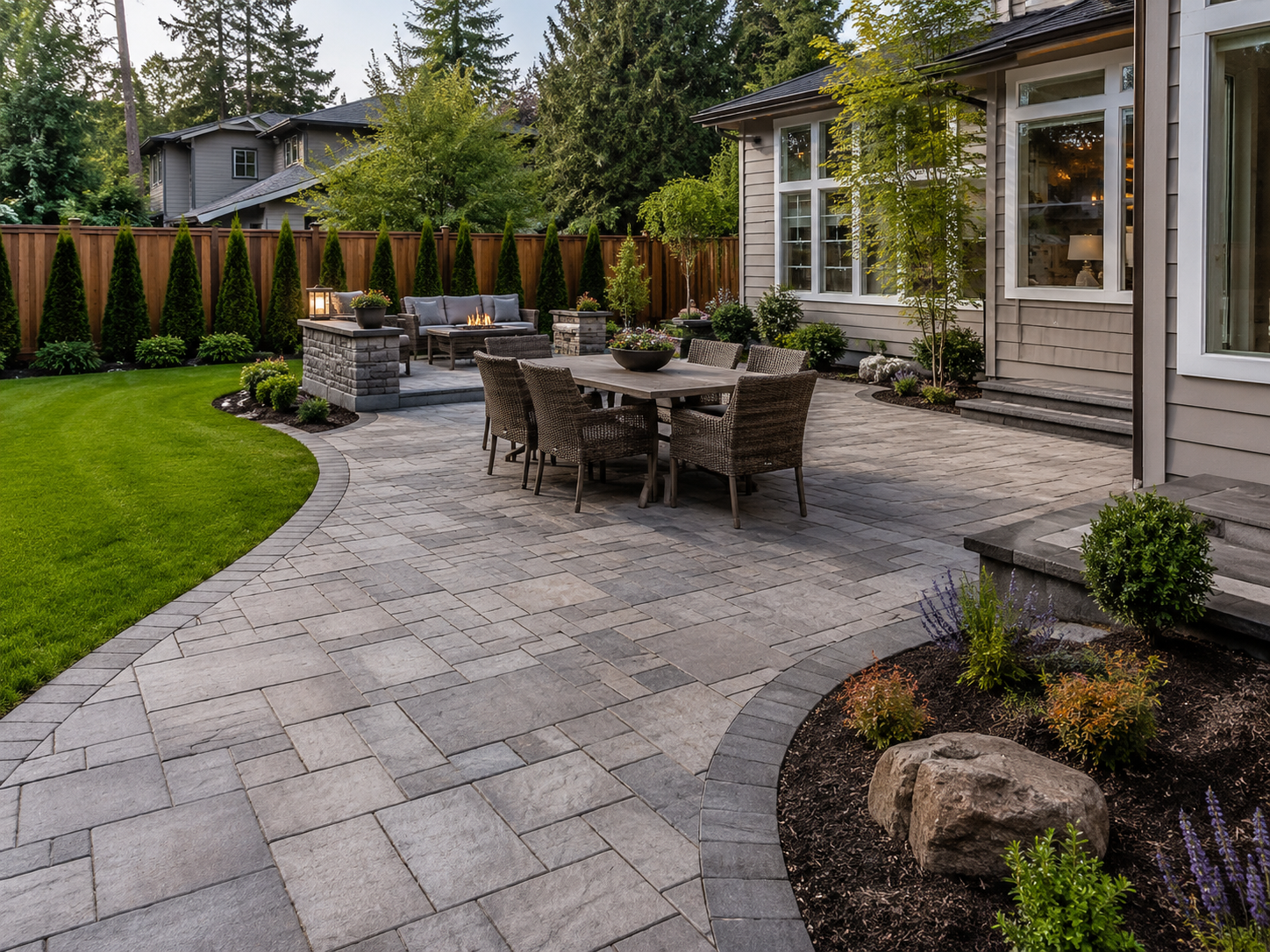
Here’s the short answer: most professionally installed paver patios in Redmond run about $20 to $45 per square foot once base prep, edge restraint, and drainage are included. For a normal backyard, that puts most projects somewhere between $6,000 and $20,000. Larger patios, premium materials, difficult access, or a sloped lot push the number higher.
That range is wider than what you’ll find on national cost calculators, and there’s a real reason for it. On the Eastside, the price of a patio has less to do with the pavers you see on top and more to do with everything buried underneath. Two quotes for the same patio can read almost identically on paper and then behave nothing alike once the first real Redmond rain shows up. We’ll get into why below.
Cost by patio size
These ranges assume a properly excavated, compacted base and drainage built for our soil. They are not the rock-bottom numbers you’ll see advertised, because those numbers usually skip the part that keeps the patio flat.
| Patio size | Rough dimensions | Typical installed cost |
|---|---|---|
| Small | 10 x 10 (100 sq ft) | $2,500 to $4,500 |
| Medium | 14 x 14 (about 200 sq ft) | $4,500 to $9,000 |
| Standard backyard | 300 sq ft | $6,500 to $13,500 |
| Large | 500 sq ft | $10,000 to $22,000 |
If a bid comes in well under these figures, that’s not a bargain by itself. It’s a signal to ask what got left out. A cheap quote and a good quote often look the same until you compare what each one includes below the surface.
What actually drives the price
Material. Standard concrete pavers sit at the lower end of the range. Tumbled, textured, and architectural pavers cost more, and natural stone or large-format porcelain costs more still. Material is the part homeowners focus on, but it’s rarely where a patio budget lives or dies.
Base and excavation. This is the real cost center. In Redmond’s soil, a patio needs a deep, well-compacted gravel base, and getting there means digging out and hauling off a lot of material. More on the soil in a minute, but the short version is that skimping here is the most common reason patios fail early.
Drainage and grading. Our rain doesn’t make drainage optional. A patio has to be pitched to move water away from your foundation, and sometimes that means adding a drain, rerouting a downspout, or regrading the surrounding soil. That work costs money up front and saves a small fortune later.
Site access. A flat backyard you can reach with a wheelbarrow or a compact machine is cheaper to build than a patio behind a house where every bucket of dirt and every pallet of pavers gets carried by hand up a slope or down a set of stairs. Access is one of the biggest hidden swings in a quote.
Slope. A lot of Eastside lots aren’t flat. Building a level, stable patio on a grade can mean extra excavation, retaining, or stepped elevations, all of which add labor.
Demolition and removal. Tearing out an old concrete slab or a failed patio adds to the total. So does hauling away the spoils from excavation.
Why Redmond costs more than the national average
A few things stack up here. Labor in the Seattle metro runs meaningfully higher than the national average, which lifts every trade including hardscaping. Beyond labor, our ground itself is the issue.
Much of Redmond and the wider Eastside sits on glacial till, a dense mix of clay, silt, sand, and gravel left behind by the ice sheets that shaped the Puget Sound lowland. Below the surface, that till is often compacted into a nearly impermeable layer called hardpan, which shows up roughly 20 to 40 inches down according to Washington State University’s soil research for the Puget Sound area. Water can’t drain down through it easily, so it collects and moves sideways instead. Build a patio on top of that without accounting for it, and you get puddling, settling, and shifting.
Add the rain load. The Eastside sees well over 40 inches of rain in a typical year, most of it in a long wet stretch from fall through spring. That combination of dense soil and steady water is exactly what a properly built patio is designed to handle, and it’s why a Redmond patio needs more base and more drainage than the same patio would in a dry climate. We compare long-term performance against poured concrete in Pavers vs Concrete Patios in the Pacific Northwest.
What a complete quote should include
When you compare bids, you’re really comparing what’s under the pavers. A thorough Redmond quote should spell out:
- Excavation depth and how much material gets removed
- Base material and compaction, usually a minimum of 6 inches of compacted crushed rock in our soils
- Edge restraint to keep the pavers from spreading over time
- Bedding layer under the pavers
- Joint stabilization, typically polymeric sand, to lock the joints and slow down weeds
- Grading and drainage, including slope away from the house and any drains or downspout work the site needs
- Cleanup and haul-off
- Warranty on both materials and workmanship
If a bid leaves base depth, drainage, access, or removal vague, it isn’t actually cheaper. It’s just incomplete, and the difference tends to surface a winter or two later.
Do you need a permit for a paver patio in Redmond?
For most backyard patios, no. Under Washington’s building code, concrete and paver patios installed at grade are generally exempt from a building permit, and Redmond specifically allows patios less than 30 inches above grade within setback areas per the Redmond Zoning Code.
There are limits worth knowing about. Redmond caps total impervious surface at 75 percent of lot area in standard residential zones, and a patio raised more than 30 inches counts toward lot coverage. Bigger projects that add 2,000 square feet or more of impervious area, or any work near a creek, wetland, or critical area buffer, can trigger a clearing and grading or stormwater review. When in doubt, a quick call to Redmond’s Development Services Center settles it, and the city’s building permit guide lays out the thresholds. A good contractor handles this for you as part of the job.
Getting an accurate number for your yard
Every one of the factors above is site-specific, which is why an honest number comes from someone standing in your backyard, not from a calculator. If you want a real figure for your space, we offer free on-site estimates for paver patio installation in Redmond, and the quote spells out exactly what’s included so you can compare it against anything else you’re weighing.